


This is a case study showcasing an engagement from our NOC Operations Consulting service. Get the full PDF of the case study here.
A software company that builds digital banking platforms for financial institutions was growing fast. As its customer base expanded, so did the demands on its Integrated Operations Center (IOC), and the extra load exposed problems in how the IOC handled incidents, staffed its shifts, and managed its processes.
The strain was showing up in the team’s everyday work:
Incidents were handled differently depending on who picked them up.
Alerts had to be copied by hand before anyone could work them.
Escalations moved over email.
For a company whose customers are financial institutions, that’s an uncomfortable place to be. Those problems put the IOC’s ability to keep service steady for them at risk exactly when the company expected to keep growing.
We were brought in to assess the IOC and recommend what it would take to turn it into an operation that could scale with the business. This was an assessment engagement, so the outcomes described near the end of this piece are projections tied to the recommendations.
Read our other NOC operations assessment case studies:
The operation we walked into
The IOC’s incident work was spread across SLAB, PagerDuty, Salesforce, and several homegrown tools. PagerDuty raised alerts while SLAB tracked incidents. The two weren’t integrated, and nothing really tied the rest of the stack together either.
On top of the tool sprawl, the team covering all of it was small relative to the workload. A few key people carried 24/7 coverage between them, and turnover was unsurprisingly high. There wasn’t a structured training program or defined career path, and new hires were often put straight into their roles without the onboarding the work demanded.
The IOC also ran remote-first. Combined with the turnover, that left people working largely on their own. Staff felt isolated, and the team lacked the more intangible (albeit critical) level of cohesion that knowledge sharing and consistent handoffs depend on.
How we ran the assessment
Over five weeks we looked at four areas: people, processes, technology, and business alignment. We interviewed stakeholders and staff, and analyzed the IOC’s tooling and processes alongside what they told us.
In the interviews, employees said they felt underprepared for complex incidents. Managers said they had trouble keeping incident handling consistent from one shift to the next.
Both groups were essentially describing the same problem from opposite ends of it.
The findings
Here’s a quick breakdown of the specific things we documented from our assessment.
1. Every alert was being handled twice
Every event PagerDuty raised had to be logged into SLAB by hand. If a server went down, someone received the alert in PagerDuty, then opened SLAB and created the ticket manually before incident management could begin.
That step cost time on every incident and opened room for human error, including misreported incidents and incidents that never got logged.
Some incidents weren’t logged correctly, which left cases unresolved or delayed.
A critical server outage could go unnoticed longer than necessary while someone cross-referenced alerts between the two systems.
Because the tools didn’t talk to each other, following an incident through its lifecycle was tough, and in many cases incidents weren’t prioritized properly. The manual process held the team back most during high-volume periods and critical events, when the team could least afford a manual step.
2. There was no single view of an incident
The fragmentation went past those two tools. Monitoring and ticketing sat in separate systems, so no one had a full picture of an incident from detection to resolution.
When a significant network issue hit, it triggered alerts in several systems at once, and the team had to correlate them by hand to find the root cause.
The CMDB was only partially integrated, which made it hard to tell during an incident which services were affected. Root cause analysis took longer. (So did the downtime.)
The process layer had the same gap. The IOC had no formal workflows for incident management, escalation, or resolution. Much of that work ran on email and manual escalation. A server failure might start an email thread when it should have triggered an automated escalation, which made the incident hard to track and raised the odds that it would be mishandled.
3. A thin team without a training program behind it
With high turnover and no structured training, the IOC had real skill gaps.
New hires struggled with complex incidents because their onboarding and technical training weren’t enough.
Many team members weren’t prepared for high-pressure situations like a critical outage, and it showed up as longer resolution times and frequent escalations to senior staff.
The subtler cost appeared during major incidents. Newer team members often lacked the situational awareness to see the broader impact of the issue in front of them. That delayed resolution, and it meant the more experienced people had to step in again and again, straining the staff the operation leaned on most.
Consistency suffered too. Expertise varied widely across the team, and without standardized processes, the same kind of incident could be handled differently depending on who picked it up.
How the findings fed into each other
These problems compounded.
Manual tooling made every incident slower, skill gaps pushed more incidents up to senior staff, and without continuous skills development, the IOC couldn’t build the capable, resilient team it needed, so the gaps kept reopening as people left.
Mark Biegler, who led the assessment, put it this way:
“When we first looked at the IOC, it was clear the team was putting in tremendous effort, but they were trapped in a cycle of manual processes and disconnected systems that slowed them down.”
Effort wasn’t the constraint. The structure around the team was.
What we recommended
The recommendations we handed to the company addressed the immediate problems while laying out what it needed to build give the IOC a base it could scale on.
Automate event management and bring the tools together
We recommended integrating SLAB and PagerDuty with a centralized ITSM platform so a ticket is created automatically for every monitored event. When PagerDuty raises a server alert, the corresponding ticket opens in SLAB on its own, and incident management starts without anyone retyping anything. Every alert gets tracked from detection to resolution.
Alongside that, we developed a plan to automate event correlation. When a server outage throws alerts from several parts of the infrastructure, the system groups them into a single incident. That cuts the noise from duplicate alerts and removes a source of human error during the incidents where errors cost the most.
The larger goal was consolidation. We recommended bringing all monitoring and ticketing into a single platform that handles both infrastructure and application events. The team would work from one dashboard with real-time tracking across every system, and they’d prioritize incidents from a complete picture instead of switching between tools to build one.
Formalize incident and change management
We designed standardized workflows for incident and change management so every incident, whatever its severity, follows a defined process. That included SLAs for response and resolution times, plus automated escalation paths that put high-priority incidents in front of senior staff immediately.
We also proposed defining the company’s NOC services in a service catalog. Incident Management, Change Management, and Major Incident Management would each have defined SLAs and OLAs, so performance and customer impact could be tracked service by service.
Build a CMDB the team can rely on
We recommended a CMDB mapping all infrastructure and application components across the company’s services. With that map in place, the system can automatically identify which services or components an alert affects, and the team can see the dependencies behind an incident without having to work them out mid-outage.

Report on the numbers automatically
We advised automated reporting on Mean Time to Repair (MTTR) and First-Level Resolution (FLR). The point was to let leadership see where the incident process was getting stuck and take proactive steps to fix it.
A few examples of the kinds of reports we build:
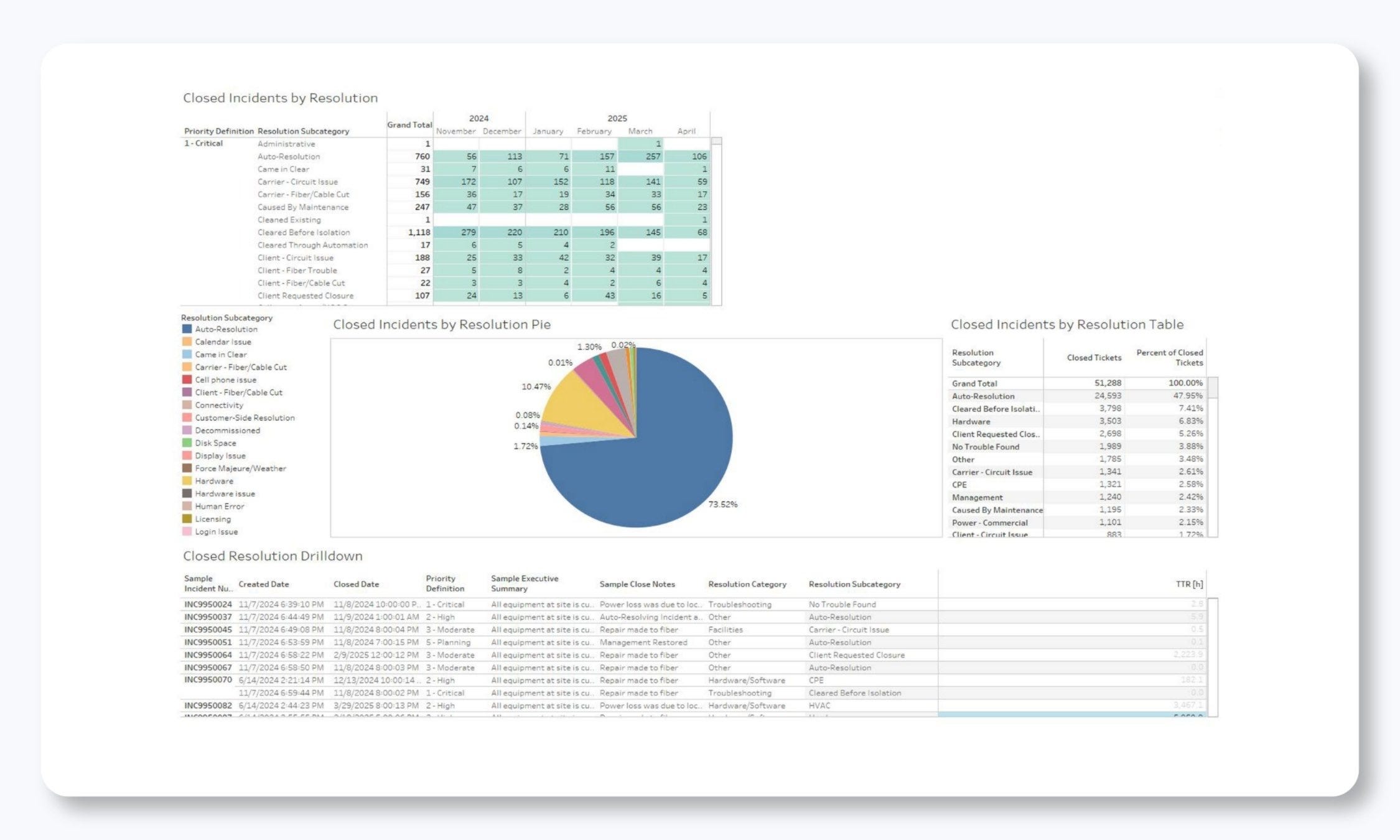
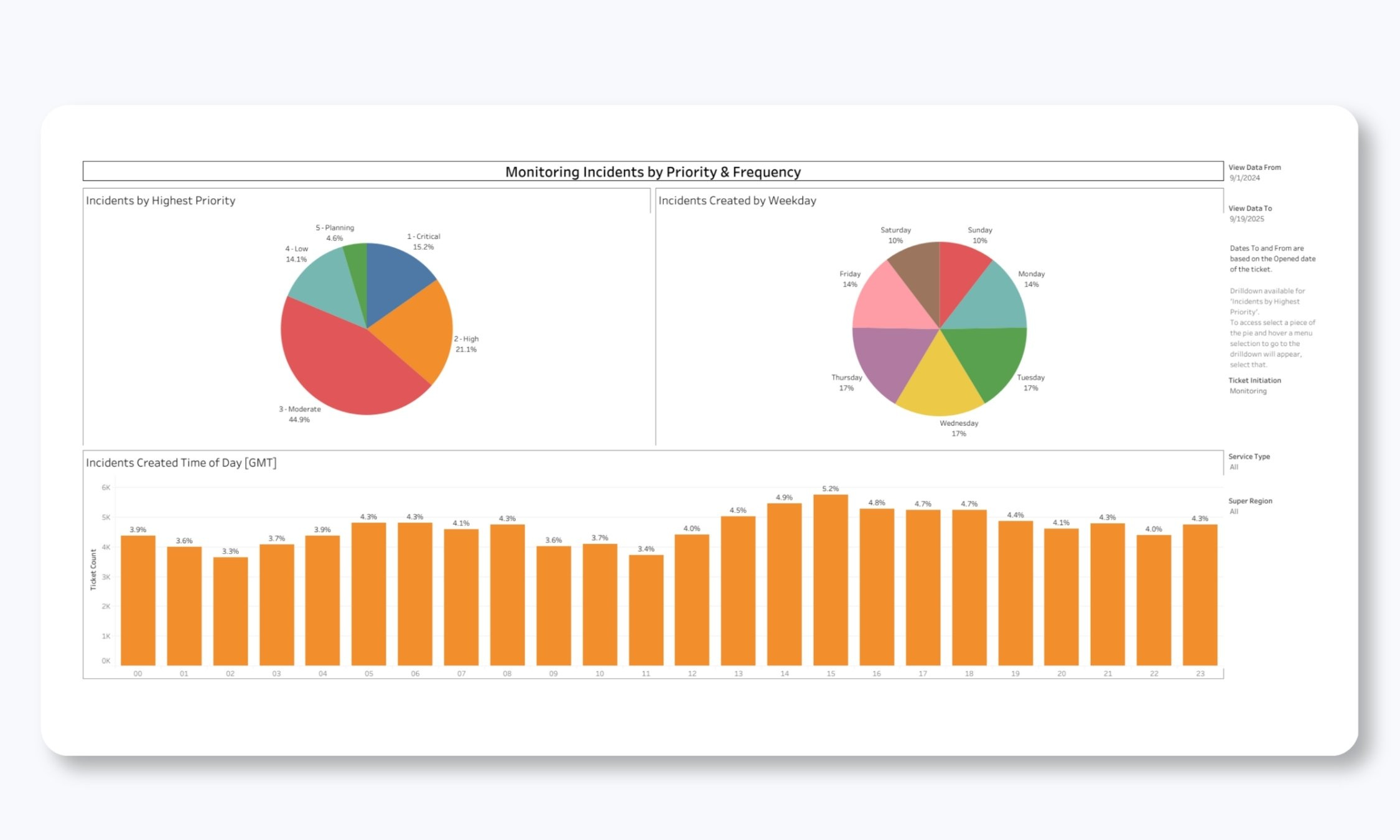
Read our in-depth piece on proper reporting: The Complete Guide to NOC Reporting in 2026
Invest in the team
The people side of the plan started with knowing where each person stood.
We recommended a competency matrix to assess every team member’s current skill level against the technical and operational needs of the IOC. That shows where each person needs to develop and keeps training pointed at the skills incident management requires.
New hires would go through a structured onboarding process of six to seven weeks, tracked in a learning management system. Established staff would get access to ongoing certifications, including AWS and Azure, along with ITIL training for service management.
Regular technical workshops and incident simulations would keep development continuous. The workshops cover root cause analysis, incident triage, and system diagnostics. The simulations recreate real scenarios, so people have worked through a high-pressure incident before they face one live.
Career progression paths go after the turnover directly. Clear advancement gives people a reason to stay, which cuts how often the company has to recruit and train from scratch. It also means less experienced team members grow into handling more on their own, escalate less often, and leave senior staff free for the complex work.
For a remote-first team that felt isolated, we suggested regular team meetings, virtual check-ins, and a mentorship program pairing new hires with experienced staff. The aim is a team that shares what it knows and handles incidents the same way regardless of who’s on shift.
What the changes are designed to produce
A few end-state goals here:
Automated ticket creation and event correlation reduce manual intervention and speed up response on critical incidents. Automated escalation gets high-priority incidents to senior staff right away.
Consolidated tools and standardized processes let the IOC manage a higher volume of incidents without being overwhelmed. The CMDB gives the team the dependency view it needs to resolve complex issues faster.
Structured training and career paths upskill the team, which means fewer escalations and better resolution times. Retention should improve along with them, leaving the IOC with a more stable and experienced workforce.
Automated KPI reporting gives leadership a real-time view of performance to base decisions on.
Growth exposed the problems here
The IOC had been getting by on effort, and effort stopped being enough once the company’s growth outran its tools and its team.
The tooling findings were the most visible part of the assessment, and integrating the tools is what makes the team faster. Mark is clear about where the larger change sits, though. “The real transformation came through investing in the team itself,” he said.
📄 The full case study, How INOC Helped a Digital Banking Platform Optimize Incident Management and Scale Its IOC, lays out the assessment findings and recommendations in full.
If your own operation looks like this one, our NOC Operations Consulting practice starts the same way: an outside assessment across people, processes, technology, and business alignment, followed by recommendations and help putting them in place without pulling your internal team off its day jobs. Contact us and we’ll follow up within one business day to set up a time to talk.

About INOC, a service of Xerox IT Solutions
INOC is an ISO 27001:2022 certified 24×7 NOC and an award-winning global provider of NOC Lifecycle Solutions®, including NOC support, optimization, design, and build services for enterprises, communications service providers, and OEMs. INOC solutions significantly improve the support provided to partners’ and clients’ customers and end users.
INOC assesses internal NOC operations to improve efficiency and shorten response times, and provides best practices consulting to optimize, design, and build NOC operations, frameworks, and procedures. Proactive 24×7 NOC support is provided with several options, including North America, EU, or APAC only or global integrated NOCs. INOC’s 24×7 staff provides a hands-on approach to incident resolution for technology infrastructure support.
Learn more about our NOC support and NOC operations consulting services. Get in touch to start the conversation. We’d love to talk NOC.